Embark on a timeless art adventure


Immerse yourself in a unique blend of art and time travel. Experience the multisensory stories of past, present, and future paintings, enhanced by UX and accessibility principles.

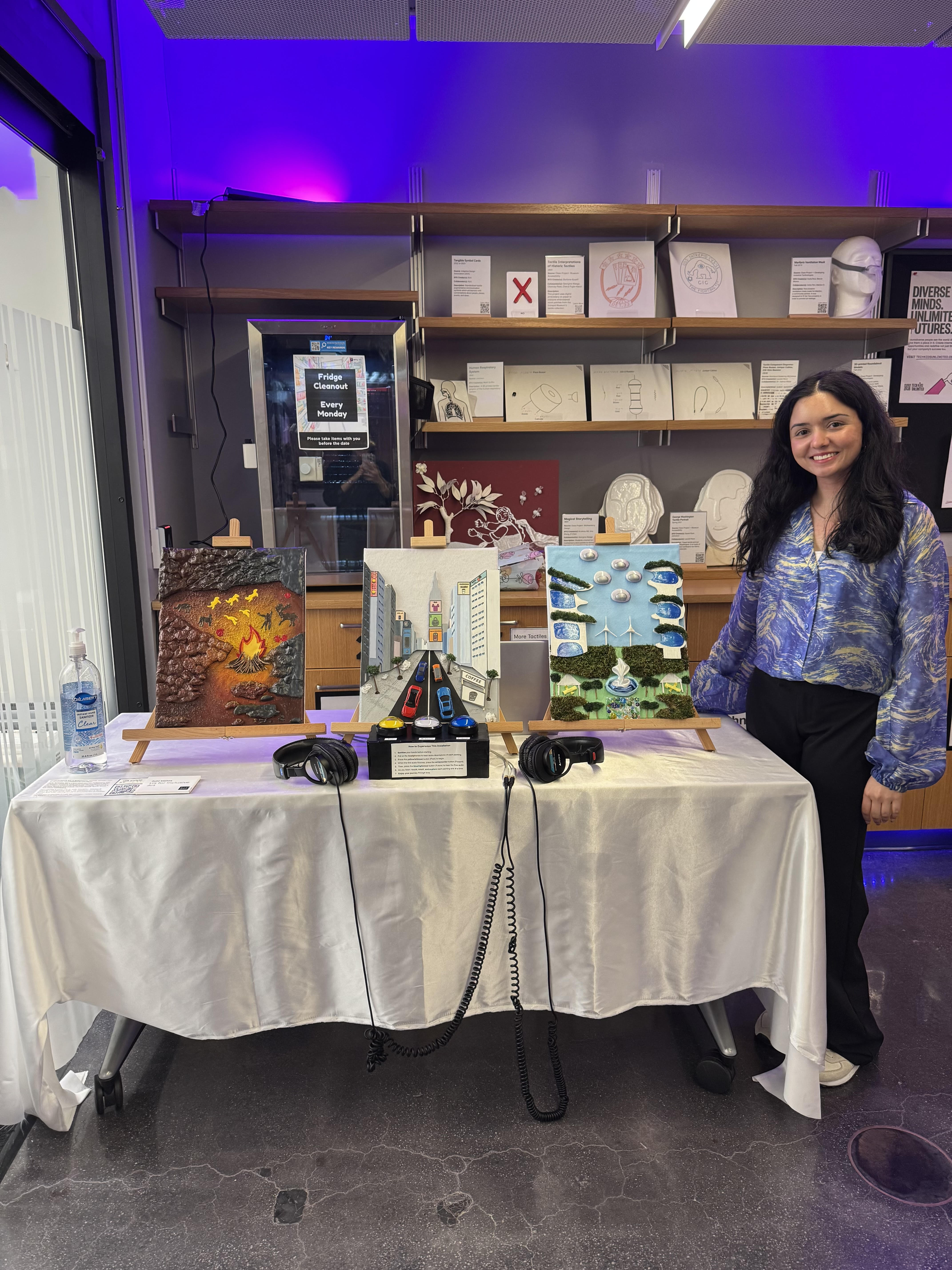
3 Tactile Paintings sitting atop easels on a table with a black box in the center showcasing 3 buttons and connected to a pair of headphones

Time-travel-themed art installation that consists of 3 tactile paintings displayed on easels sitting atop a table with 3 buttons embedded in a black box placed in front and connected to a pair of headphones

Embark on a Sensory Adventure

Step into a world where art meets sound, touch, and scent

Multisensory Art
UX Design
UX research
arduino/C++
Prototyping
Accessible Design
User Testing

Touch the echoes of history

Step into the prehistoric world, where time begins not in words, but in stone, fire, and drawings.

Feel the rhythm of now

Enter the constructed chaos of the present — a world built on movement, consumption, and concrete.

Walk the path of possibility

Immerse yourself into imagined tomorrows — where human life is woven gently into the landscape.

Touch the echoes of history

Tactile Painting of the Past

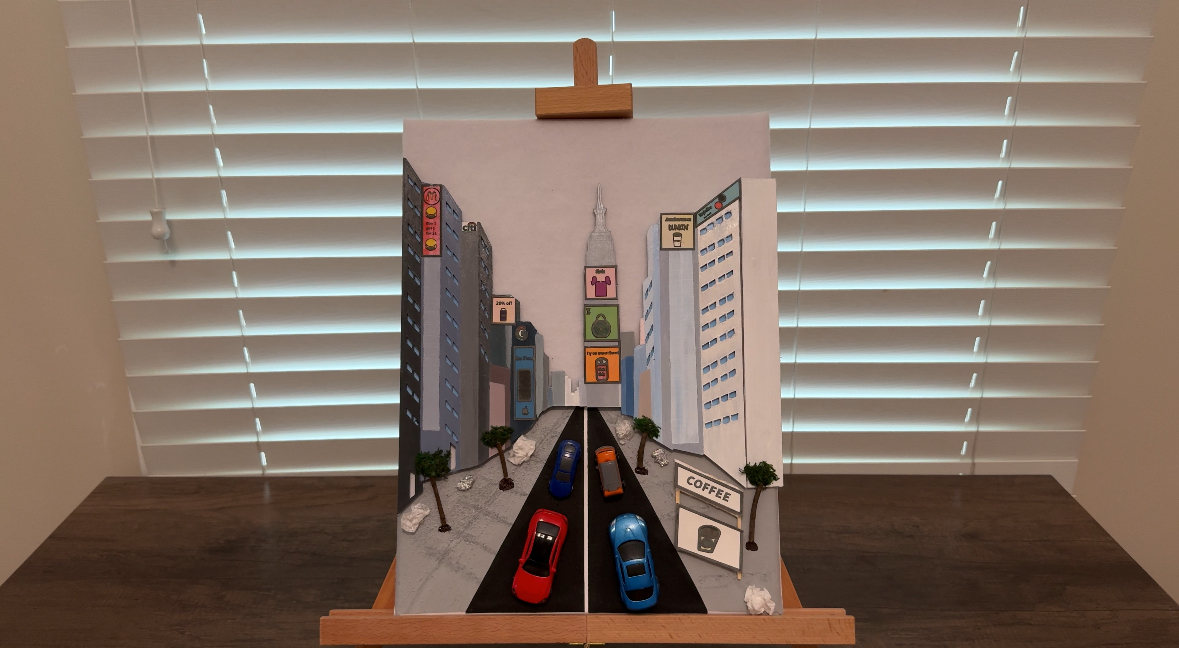
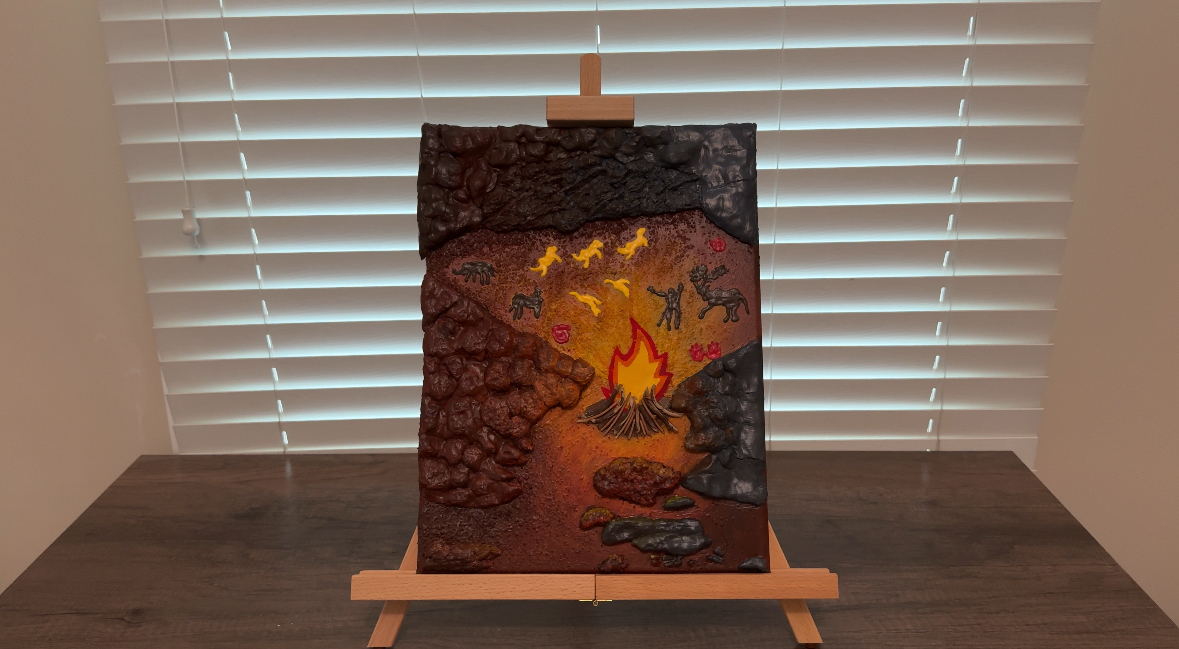
Past painting displayed on an easel atop a table


Step into the prehistoric world, where time begins not in words, but in stone, fire, and drawings. Feel the warmth of a fire crackling nearby, casting flickering shadows on the jagged walls. Your fingers graze the rough, ancient surfaces, each bump and contour telling its own story of survival. Above you, the walls come alive with the handprints and animal figures of those who once lived here — the raw, unspoken stories of a people who expressed themselves through paint and stone. This is a place where history doesn’t speak, it is felt in the air, the warmth, and the pulse of a world long passed but never forgotten.

Audio Description Transcript:
Welcome, traveler.
You’ve stepped into the prehistoric past—a world of stone and flame,
where stories lived on the walls. Begin at the top left corner of the painting.
Touch the cool, bumpy clay wall, painted a deep maroon.
As your hand moves diagonally downward and slightly to the right,
the texture shifts to rougher, uneven paper mache— the inner cave, where light fades and echoes linger.
Now guide your hand left to right across the wall.
The bumpy surface slowly smooths,
as maroon fades to gray—a tactile path through time. Reach the center wall—made of acrylic paint and sand.
It starts gritty, but smooths as you move rightward—
like memory softened by time. From left to right, you can also find smooth raised puff paint cave wall art:
a wooly mammoth, goat, birds, a human alarmed by an elk, spirals, and ancient handprints
in yellow ochre, burnt sienna, and rich brown.
Now feel the campfire at the bottom center—
wooden sticks, cotton fabric flames in reds, oranges, and yellows,
scented with campfire essential oil, warmed by a hidden heat pad.
Moving further down and from the left to the right,
you will feel the bumpiness of the clay and paper mache walls, rocks, and the gritty ground becoming smoother.
This is the beginning.
Where humans first shared warmth, meaning, and memory.
When you’re ready…
Press the middle button to travel to the Present.

Feel the rhythm of now

Present painting displayed on an easel atop a table


Enter the constructed chaos of the present — a world built on movement, consumption, and concrete. The rhythm here is mechanical: the honk of traffic, the glare of ads, the hum of endless growth. Towering structures prioritize speed over stillness, profit over people. This is the era of capitalism’s grip — where time is monetized, cities sprawl for cars not communities, and the air itself bears the weight of consequence. You are invited to stand in this friction — to feel the dissonance between progress and preservation, and question the cost of ‘now.’

Audio Description Transcript:
Welcome, traveler.
You’ve arrived in the Present—a world built for cars, productivity, and money.
Start at the top left. Glide your fingers over smooth skyscrapers made from laser-cut acrylic.
From left to right, their colors shift—dark gray to pale blue to white—hinting at the future.
Feel the sharp-edged windows, clean and precise like modern architecture.
Move rightward. More buildings rise, packed tightly like thoughts in a busy mind.
Your fingers meet raised ads on swellform paper—fast food, new iPhones, clothes, makeup, coffee.
They’re loud in silence—a tactile flood of consumer culture.
At the top center, a tall building rises beneath a gray felt sky—soft yet heavy with pollution.
Now move down to the road—rough black sandpaper.
Follow its gritty path to plastic toy cars, sleek and stuck in traffic.
On both sides of the road, sidewalks feel coarse—salt mixed with acrylic paint.
You can also pass small trees: wooden trunks, synthetic moss, lonely bits of green in a gray world.
At the bottom right, you can find the wooden coffee stand.
Raised swellform signs greet you—and a bittersweet whiff of coffee essential oil.
Up and down the sidewalks, scattered garbage catches your fingers—crumpled napkins, bits of plastic.Leftovers from a world in motion.
This is the Present: Fast. Built-up. Branded.
Fraying at the edges.
When you’re ready…Press the rightmost button to journey into the Future.

Walk the path of possibility

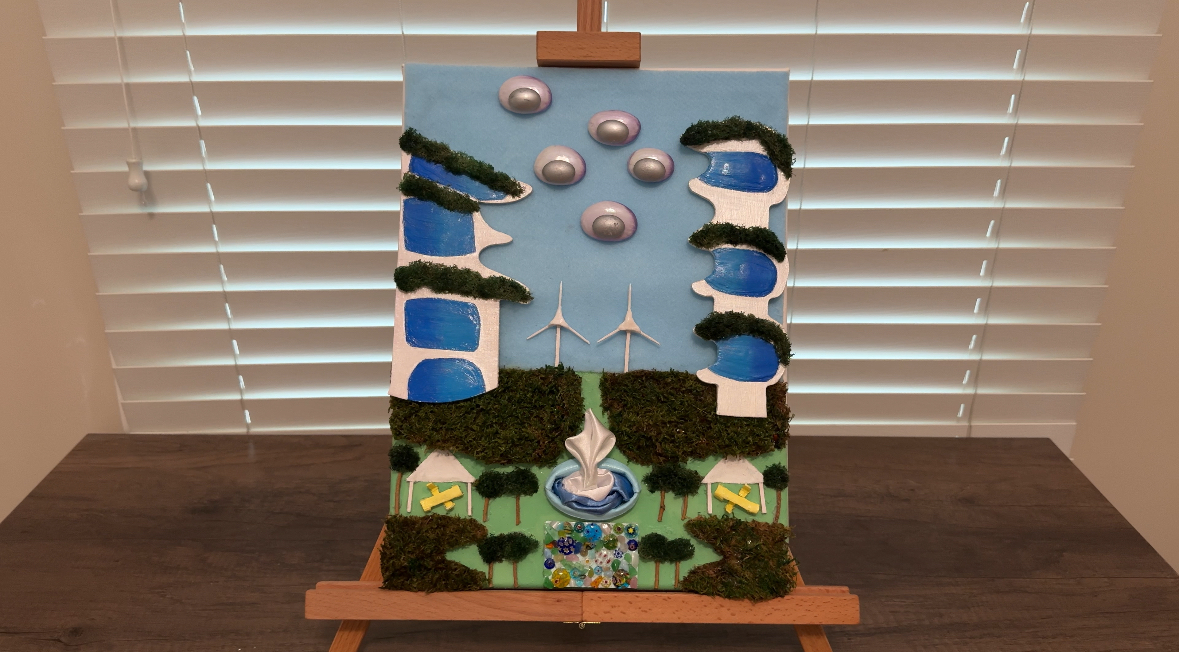
Future painting displayed on an easel atop a table


Immerse yourself in a world where gardens thrive and greenery wraps gently around shared spaces. A quiet fountain offers stillness, its sound mingling with the breeze. Community-centered architecture rises with intention — open, welcoming, built for gathering and care. Wind turbines turn slowly in the distance. A floral mural, vivid and thoughtful, tells a collective story of renewal. Here, sustainability is second nature, and the boundary between the built and natural world dissolves. This is a future shaped by harmony, creativity, and deep connection.


Audio Description Transcript:
Welcome, traveler.
You’ve arrived in the Future—a world renewed: peaceful, vibrant, and alive with balance.
Begin at the top left.
Feel the smooth curves of a pearlescent white futuristic building, laser-cut from birch wood.
Run your fingers over its acrylic-paste windows, raised and painted in sky-blue shades.
Feel the mossy decor in between windows.
To the right, a second building appears—each level crowned with soft, earthy moss.
Above, touch the sky—light blue felt, calm and clear.
At the top center, hoverpods float—smooth glass domes ringed in purple and silver, drifting in motion.
Move downward to the center. Here stand two white wind turbines, sculpted from clay and wood.
Just below, a fountain flows—its silky fabric water cascading into a biodegradable paper bowl, light and delicate.
Trace the light green pathways around it, textured with salt for a subtle grain.
Feel the real moss grass - scented faintly of soil and rain - and tiny moss-topped trees, surrounding white fabric tents held by wooden sticks.
Inside each tent, yellow cardboard tables and chairs invite gathering—a sign of community.
At the bottom center, explore an art mural of colorful floral glass beads and gemstones.
A celebration of creativity.
This is a world shaped by care. By sustainability. By connection.
You’ve reached the end of your journey.
You may return now—back to the world you came from.
But perhaps…
you’ll carry a piece of the future with you.


Sound

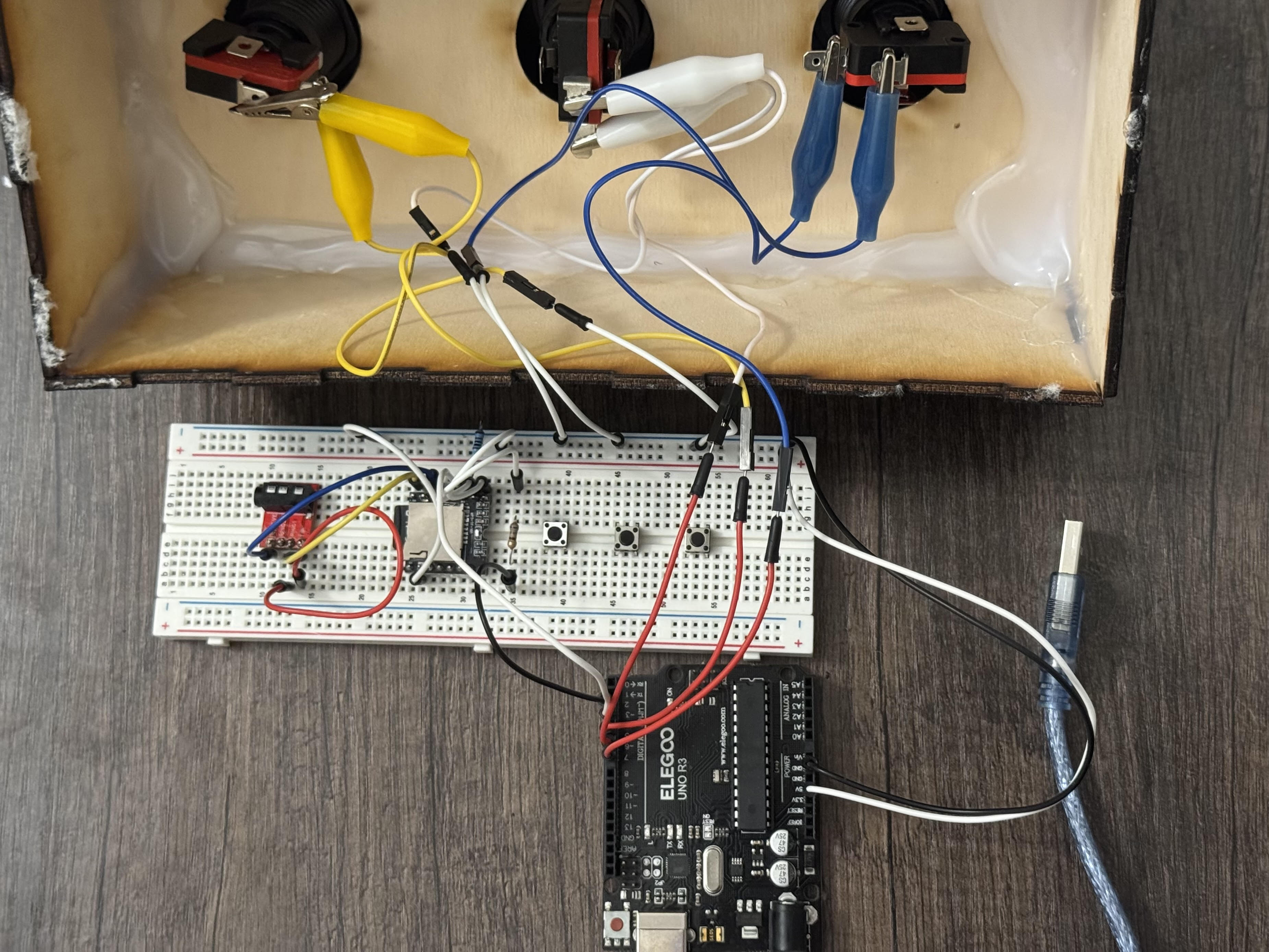
Arduino with wires connected to breadboard and other micro components with longer wires connected to 3 arcade buttons through holes of a box


Sound created with arduino, 3 arcade buttons, and C++. Box built with makercase.com and laser-cut birchwood.

Code:

#include "SoftwareSerial.h"
#include "DFRobotDFPlayerMini.h"

// Use pins 2 and 3 to communicate with DFPlayer Mini
static const uint8_t PIN_MP3_TX = 2; // Connects to module's RX
static const uint8_t PIN_MP3_RX = 3; // Connects to module's TX
SoftwareSerial softwareSerial(PIN_MP3_RX, PIN_MP3_TX);

int btn_track1 = 5;
int btn_track2 = 6;
int btn_track3 = 7;

// Global variables
int track_selection = 1; // current track selection

// Create the Player object
DFRobotDFPlayerMini player;

void song (void);

void setup()
{
  // Setting up buttons on pins as inputs
  pinMode(btn_track1,INPUT_PULLUP);
  pinMode(btn_track2,INPUT_PULLUP);
  pinMode(btn_track3,INPUT_PULLUP);


  // Init USB serial port for debugging
  Serial.begin(9600);
  // Init serial port for DFPlayer Mini
  softwareSerial.begin(9600);

  // Start communication with DFPlayer Mini
  if (player.begin(softwareSerial)) {
    Serial.println("OK");

    // Set volume to maximum (0 to 30).
    player.enableDAC();
    player.volume(20);
    // Play the "0001.mp3" in the "mp3" folder on the SD card
    //player.playMp3Folder(1);

  } else {
    Serial.println("Connecting to DFPlayer Mini failed!");
  }
}

void loop() {
  // Checking if a button is being pressed
  while(digitalRead(btn_track1)== LOW || digitalRead(btn_track2)== LOW || digitalRead(btn_track3)== LOW)
  {
    if (digitalRead(btn_track1) == LOW)
    {
      //pause the playback
      player.pause();
      // Change the song selection
      track_selection = 1; //
      // WAIT until play/pause is released
      while(digitalRead(btn_track1)==0);
      delay(200); // "breathing room"
      song();
    }
    else if (digitalRead(btn_track2) == LOW)
    {
      player.pause();
      track_selection = 2;
      while (digitalRead(btn_track2) == LOW);
      delay(200);
      song();
    }
    else if (digitalRead(btn_track3) == LOW)
    {
      player.pause();
      track_selection = 3;
      while (digitalRead(btn_track3) == LOW);
      delay(200);
      song();
    }
  }
}

void song (void)
{
  player.playMp3Folder(track_selection);
  Serial.println("Playing track:");
}


Methods

  • Interview: With an accessible artist to learn about their process.
  • Ethnography: Museum observations of people, artwork, and accessibility integration at the Cooper Hewitt, Smithsonian Design Museum.
  • Activity-Based Workshop: Art workshop participation and observation at the "Seeing Through Drawing" workshop at the Metropolitan Museum of Art.
  • User Testing: A/B testing of different materials to create the right textures and scents.

The Process

1. Defining the problem

This project began with a core question:
How can artists use UX design principles as a guide to make their artwork accessible to a diverse audience?
Many traditional exhibitions rely heavily on sight. My goal was to create a time-travel-themed art installation that invites all users, regardless of visual ability, to engage meaningfully through touch, sound, and smell. The challenge was to design an experience that is intuitive, immersive, and accessible.

2. Research

To understand how inclusive, multisensory experiences can work in practice, I used 3 research methods:

  • Interview: I spoke with an accessible artist to learn about their creative process and how they design for sensory inclusivity. This provided personal insight into how accessibility and artistry can work together.
  • Ethnography: At the Cooper Hewitt, Smithsonian Design Museum, I observed visitors interacting with exhibits—especially where accessibility features (like touchable models and audio guides) were integrated. This helped me identify both successes and gaps in current museum accessibility.
  • Activity-Based Workshop: I participated in the "Seeing Through Drawing" workshop at the Metropolitan Museum of Art, where blind and low-vision participants explored drawing through tactile engagement. Observing the tools, facilitation techniques, and participant responses deepened my understanding of inclusive art-making.

3. Analysis & Planning

After gathering insights, I moved into planning with a user-centered approach:

  • User Stories: For example: “As a blind visitor, I want to know what the painting is, so I can engage with it meaningfully.”
  • Personas: I created fictional profiles of different users, such as a blind museum-goer, a neurodivergent visitor, and a sighted and neurotypical audience member. Each persona had unique needs and goals, helping guide design decisions.
  • Journey Mapping: I mapped out each visitor’s interaction with the artwork, from discovering the installation to exploring the tactile surfaces, smelling the scent elements, and activating the audio descriptions using buttons.

4. Design Phase

With the planning foundation in place, I began designing:

  • Sketches: I drew early concepts for each of the three paintings, considering layout, texture placement, and interaction zones.
  • Digital Mockups: These refined versions included the positioning of tactile elements, scent points, and buttons for activating audio descriptions.

5. Prototyping

I built physical prototypes for key parts of each painting, testing different textures, materials, and scent dispersal methods. I also created mock audio setups using placeholder sounds to simulate the experience of activating each painting.

6. Testing Round 1

I tested these early prototypes with peers and an accessibility specialist. The feedback helped me evaluate:

  • Tactile clarity (Could users distinguish parts of the painting by touch?)
  • Scent effectiveness (Were the smells noticeable but not overwhelming?)
  • Button usability (Were they easy to locate and press?)

7. Iteration & Final Painting Build

Based on feedback, I revised each painting:

  • Adjusted materials for better tactile contrast.
  • Modified scent amounts and positioning.
  • Improved physical accessibility of buttons.

Each painting went through multiple rounds of refinement before reaching a final form.

8. Audio Experience Development

Next, I focused on sound:

  • Writing Descriptions: Each audio description was carefully written to tell a vivid, sensory-rich story of the painting.
  • Feedback & Editing: I shared drafts of the scripts and revised them for clarity and tone.
  • Recording & Editing: I recorded the narration and layered in sound effects that support the time-travel theme.
  • Sound Testing: After integrating the recordings, I tested the audio with users and made final edits by adding a subtle background ambiance to create a more immersive audio space.

9. Hardware Integration: Arduino & Coding

I used an Arduino with a DFPlayer Mini module to control the audio for each painting. Each tactile piece includes a button that, when pressed, plays its corresponding audio description through headphones. With the help of a mentor, I wired everything and wrote C++ custom code to ensure a responsive and reliable interaction. To place the buttons in a convenient way, I used makercase.com to create a wooden box and screwed the buttons inside the cut holes.

10. Final Testing & Refinement

With the physical build and sound design complete, I conducted final usability testing for all three paintings. Feedback from this round helped me fix small issues (like button labeling and audio volume), ensuring the final experience was smooth and inclusive.

More about the work

What sparked this creation?

This project emerged from a passion to create physical art with a UX approach, crafting a time-travel journey that captivates the senses and invites inclusivity.

How does the experience unfold?

With headphones, visitors embark on an auditory journey, receiving guidance and engaging with the paintings through touch and smell, enriching their sensory adventure.

Why emphasize UX and accessibility?

By integrating UX and accessibility, the installation becomes a welcoming space for all, ensuring an engaging and inclusive artistic experience.

What materials bring it to life?

Each artwork is a tapestry of various textures mentioned in the audio description and transcript, inviting tactile exploration and deepening the connection between the visitor and the art.

What is the audio journey like?

The audio helps users imagine as if they are time-traveling and gives them the opportunity to focus on their senses while interacting with the paintings to engage with art in a deeper way.

What message does it convey?

This artwork reflects on the story of humanity and the steps that we can take as a collective to create a better future. Most importantly, it encourages artists to create artwork in an accessible way so that all visitors can enjoy art.


About the Artist

The artist standing next to her installation

Juhi Mehta is an inclusive artist and a UX designer/researcher. This installation is the outcome of her thesis exploring how UX principles can be applied to create accessible, multisensory art experiences. She completed her Master’s in Integrated Design and Media from NYU. Juhi’s work blends UX design, UX research, accessibility, and front-end development to build thoughtful, user-centered experiences. You can explore more of her projects on her portfolio.

Contact
jmehta.ux@gmail.com
LinkedIn